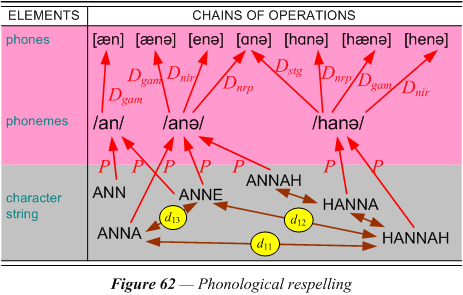
Dialectal respelling. Using the most basic kind of respelling the clerk-recorder takes into account the sound of the name in his native language and dialect. At one stage the native language claims various linguistic sounds to be for purposes the “same.” This phonemic level of analysis is a rough equivalence of many sounds, that in different populations in different localities and periods of time are classed as different accents. Sometimes the clerk-recorder takes such differences into account, recognizing the name and spelling it as he might be accustomed to spelling it. In this case the spelling has the effect of neutralizing the differences in pronunciation due to the idiolect of the informant. At other times the name is not recognized by the clerk-recorder and he spells it as he would other, to him, similar sounding names. Figure 62 illustrates how the name spelling differences at the orthographic level may be expressed in terms of a phonemic representation. This is a many-to-one relationship of spelling to pronunciation. The phonemes, however, diversify systematically among the populations in different localities to produce a one-to.many relationship of conceptual sounds to articulated sounds.
English is perhaps a little extreme for manifesting a large number of accents which a popular and widespread language can exhibit. Linguists who have studied the English dialects in detail have characterized systems of relationships between several dozen accents. Today these fall into two large classes: General American (GAM), and Non-Regional Pronunciation (NRP). The former accents are located in North America, whereas the latter are concentrated on the British Isles. There is only one of these regional accents shown on the figure: Northern Ireland (NIR). In addition to these, there are other varieties of English spoken in other parts of the world: Australia, New Zealand, Singapore, India, South Africa, Canada, and other places like Sierra Leone and certain islands in the Caribbean. All of these varieties show variation over time. Thus, there have been stages of development: Anglo-Saxon (before 1350), Middle English (1350–1450), Early Modern English (1450–1550), Modern English — Classical (1550–1650), Modern English — Regular (1650–1750), Late Modern English (1750–1850), Queen’s English (1850–1950). Whether accents are examined in time or place, most of the variation is found to occur in the pronunciation of the vowel sounds, all but a couple of the IPA standard phones being represented.
